



World Chess Championship 2026: Gukesh vs Sindarov Guide
Gukesh vs Sindarov schedule, start times in your time zone, the 7.5-point format and prize money, plus how to follow every game live with Ziuk.
Two 20-year-olds. One world title.
Defending champion Gukesh Dommaraju faces challenger Javokhir Sindarov in the 2026 World Chess Championship, starting November 24 in Cologny, near Geneva, Switzerland. It’s the youngest world championship match in history, with both players competing for the title and a $2.5 million prize fund.
Here’s everything you need to know about the match, including the full schedule, start times, format, prize money, and how to follow every game live with Ziuk, Chessify’s AI chess assistant.
What are the World Chess Championship 2026 essentials?
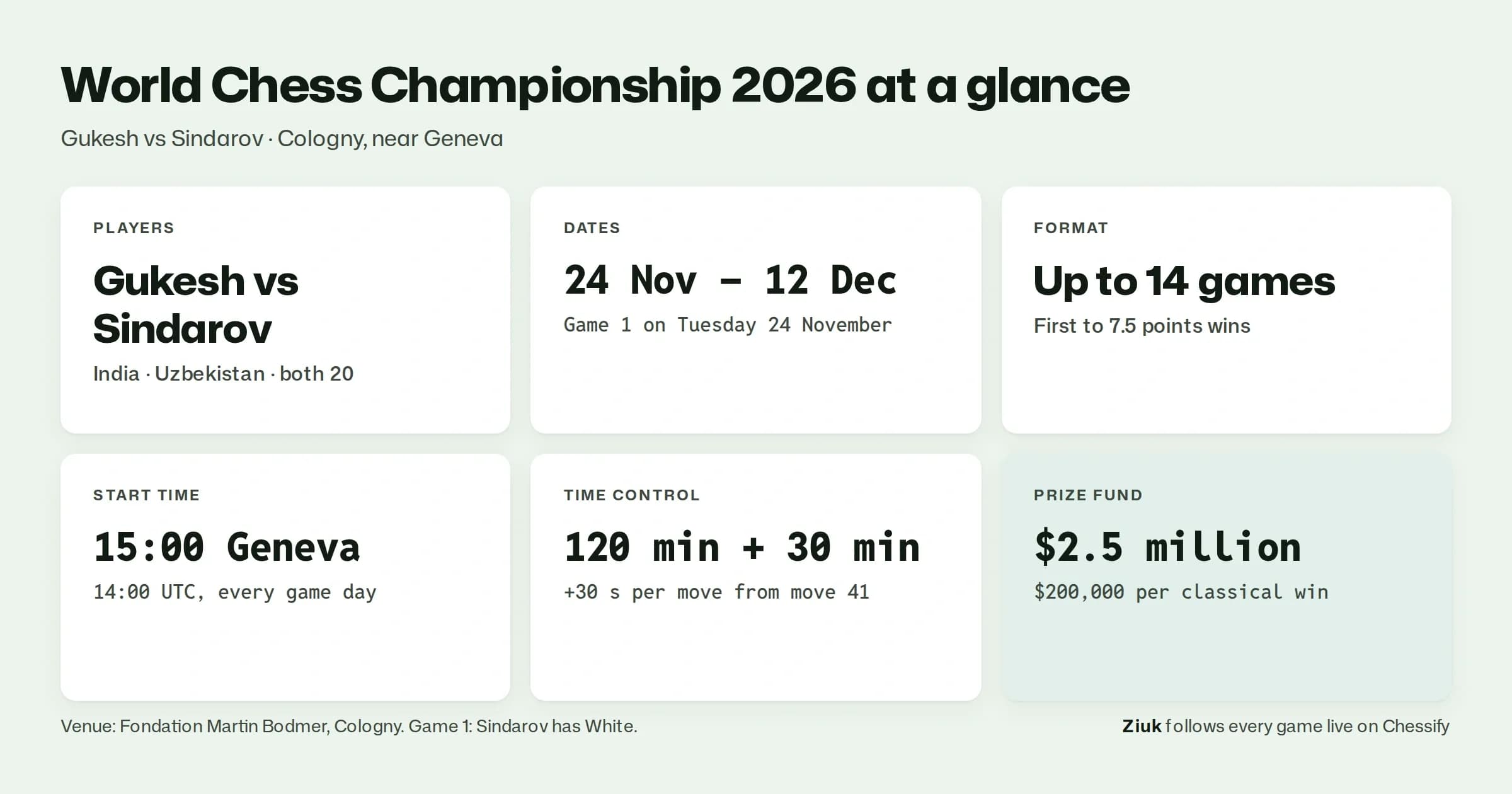
- Players: Gukesh D (India, defending champion, rating around 2710) vs Javokhir Sindarov (Uzbekistan, challenger, rating 2782, world No. 4)
- Venue: Fondation Martin Bodmer, Cologny, Geneva, Switzerland
- Dates: November 24 – December 12, 2026 (opening ceremony November 22)
- Format: Up to 14 classical games, with a rest day after every three games
- Start time: 15:00 Geneva time (14:00 UTC) on each game day
- Time control: 120 minutes for the first 40 moves, then 30 minutes for the rest of the game, plus 30 seconds per move from move 41
- Prize fund: $2.5 million
- Game 1: Sindarov plays White
Gukesh is defending the title he won in 2024, while Sindarov is making his first World Championship appearance. The first player to reach 7.5 points becomes world champion. If the match ends 7–7 after 14 games, the title will be decided in tiebreaks on December 12.
What is the Gukesh vs Sindarov schedule?
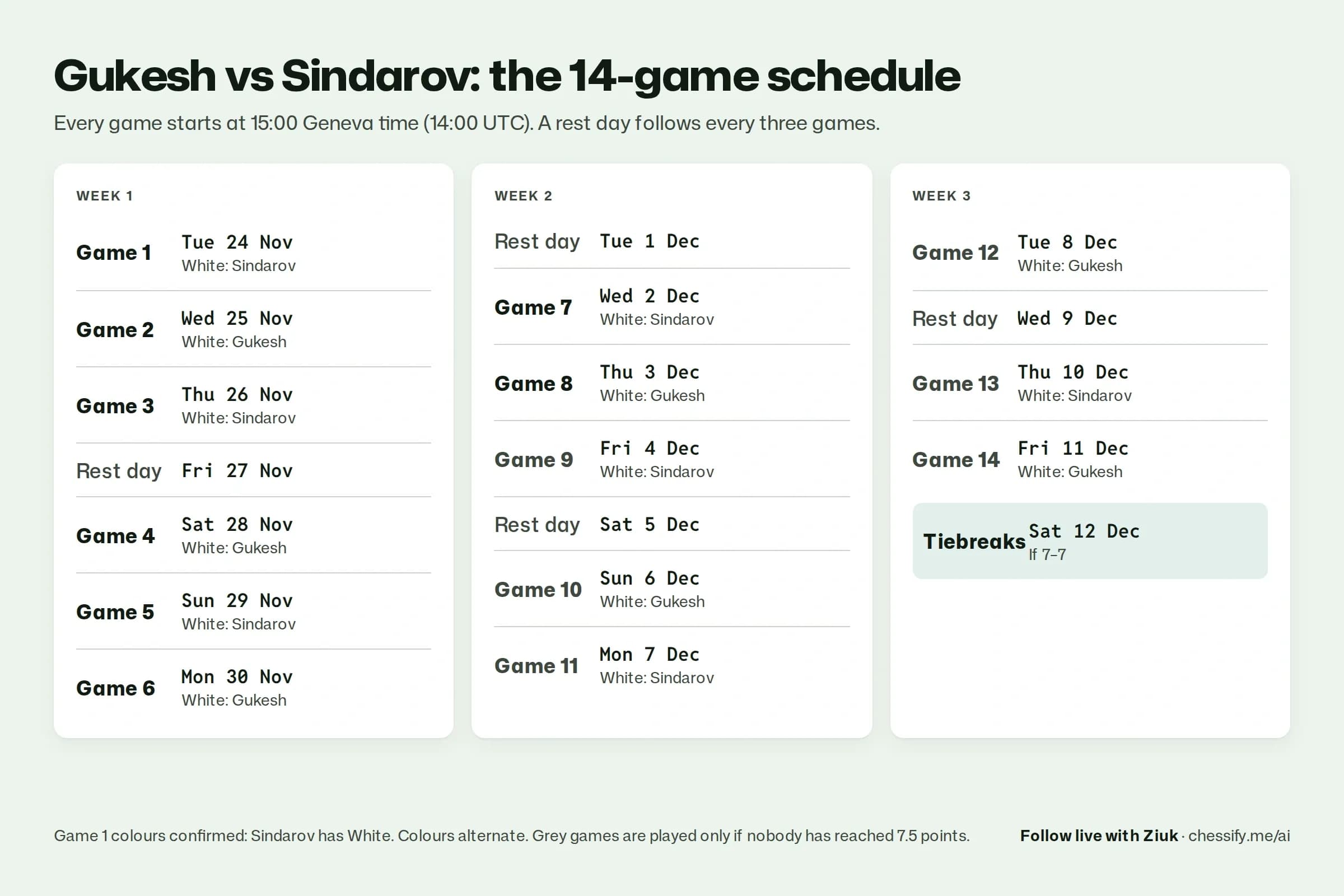
Game 1 takes place on Tuesday, November 24, with Sindarov playing White. The players will alternate colors throughout the match, with Sindarov playing White in odd-numbered games and Gukesh in even-numbered games.
The schedule includes 14 classical games, but the match ends as soon as either player reaches 7.5 points.
What time does each game start in your time zone?
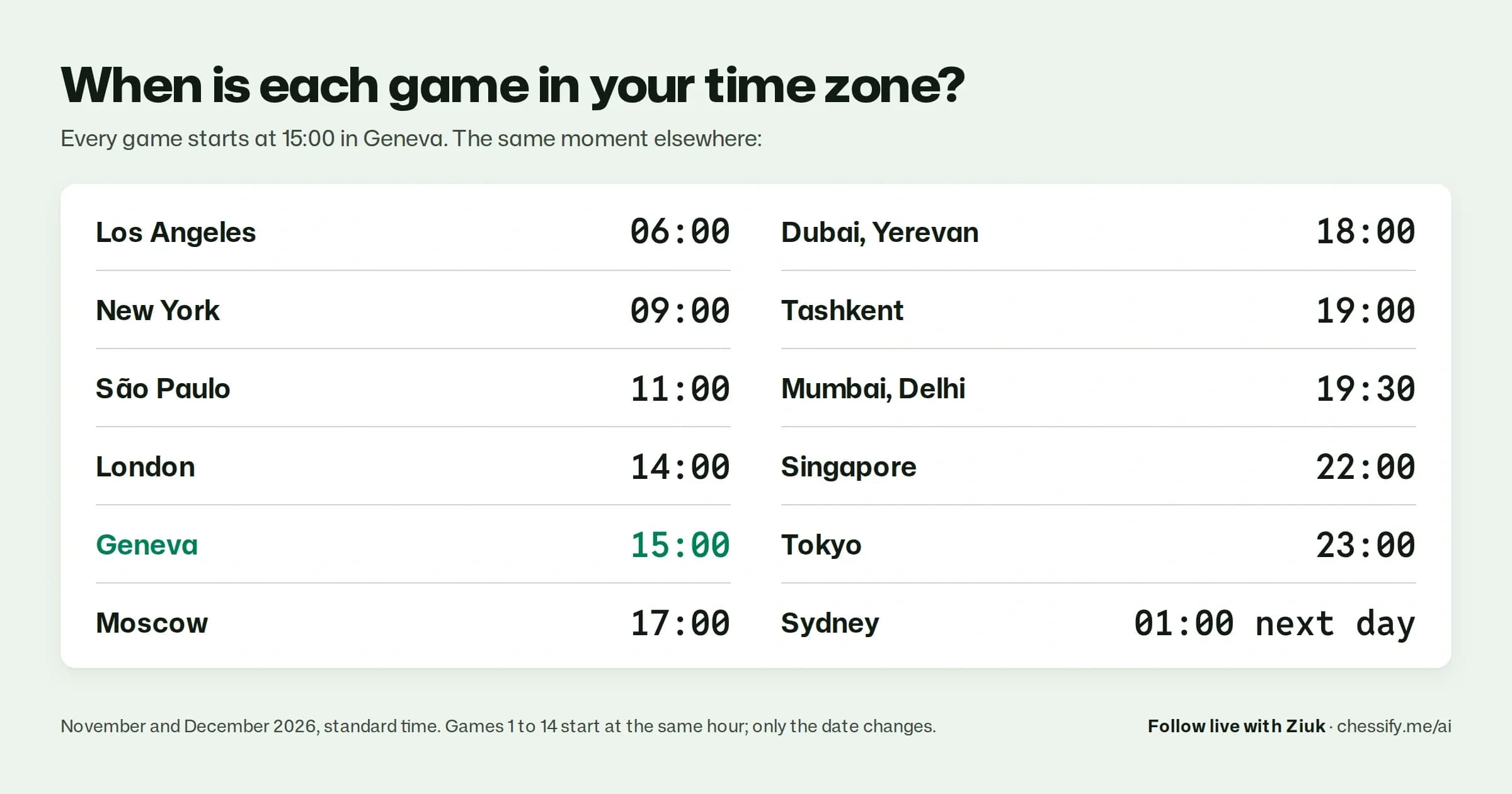
Every game begins at 15:00 in Geneva (CET). Here’s when to tune in from different parts of the world.
The start time remains the same throughout the match. You can open the live board on Chessify a few minutes before the first move to follow the action from the beginning.
What is the World Chess Championship format?
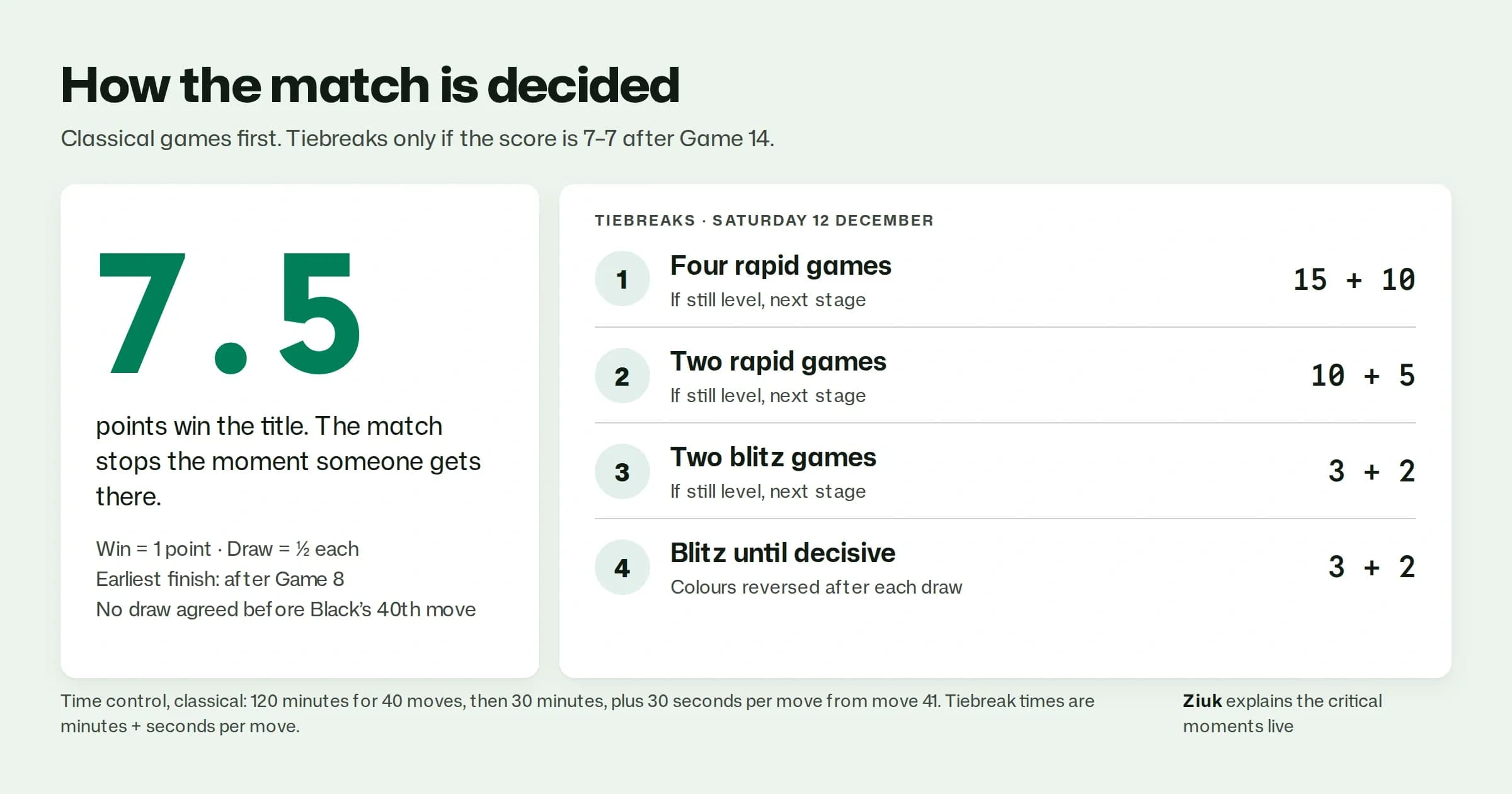
The match consists of up to 14 classical games. Players receive one point for a win and half a point each for a draw.
The first player to score 7.5 points wins the World Championship, even if there are games remaining on the schedule.
Theoretically, the match could end after just eight games, although that would require an exceptionally dominant performance.
What happens if the match is tied?
If the score is 7–7 after Game 14, the players will compete in faster games on December 12 until a winner is determined.
The tiebreak format is:
- Four rapid games with 15 minutes per player, plus 10 seconds per move.
- If still tied, two games with 10 minutes plus 5 seconds per move.
- If still tied, two blitz games with 3 minutes plus 2 seconds per move.
- If necessary, additional 3+2 blitz games, with colors reversed after each draw, until one player wins.
How much time do the players have?
In each classical game, both players receive 120 minutes for their first 40 moves. After move 40, they get an additional 30 minutes, with a 30-second increment starting from move 41.
Players are also not allowed to agree to a draw before Black’s 40th move. This encourages them to play out positions rather than settle for an early draw.
Who are Gukesh and Sindarov?
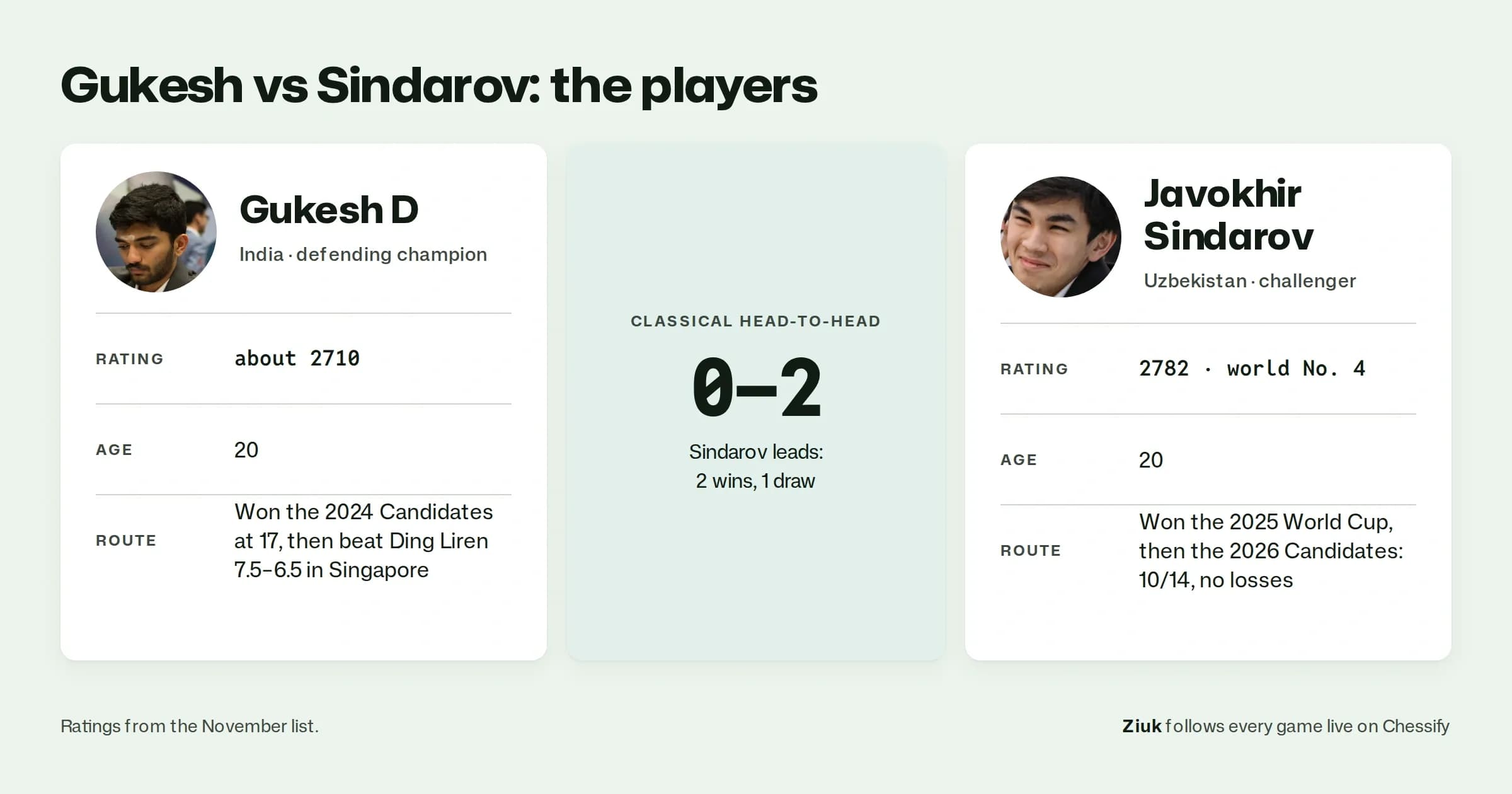
Photos: Gukesh by Frans Peeters, CC BY-SA 2.0; Sindarov by TheBoburshokh, CC BY 4.0, via Wikimedia Commons
How did Gukesh become world champion?
Gukesh Dommaraju made history in 2024 when he won the Candidates Tournament at just 17 years old.
Later that year, he defeated Ding Liren 7.5–6.5 in Singapore, becoming the youngest undisputed world chess champion in history.
Now 20, Gukesh returns to defend his title, entering the match with a rating of around 2710.
How did Sindarov earn his title match?
Javokhir Sindarov qualified for the World Championship by winning the 2026 Candidates Tournament in Cyprus, following his victory at the 2025 World Cup.
His Candidates performance was particularly impressive: 10 points from 14 games, six wins, and no losses. He finished 1.5 points ahead of runner-up Anish Giri.
With a rating of 2782 and a world ranking of No. 4, Sindarov enters the match 72 rating points ahead of Gukesh.
What is the Gukesh vs Sindarov head-to-head record?
Sindarov leads their classical head-to-head record with two wins and one draw.
He defeated Gukesh at the Moscow Open in 2018 and again in Sharjah in 2022. Their most recent classical encounter, at Tata Steel in January 2026, ended in a draw.
Gukesh did defeat Sindarov in a rapid game in Warsaw earlier this year, although rapid and classical chess present very different challenges.
Who is the favourite?
Sindarov enters the match as the favourite according to several leading players and commentators.
Magnus Carlsen described him as a “significant favorite”, while Fabiano Caruana estimated his chances at approximately 55–45. Praggnanandhaa, meanwhile, considers the matchup evenly balanced.
Sindarov has the rating advantage, better recent results, and a stronger classical head-to-head record.
But Gukesh has something his challenger doesn’t: experience playing and winning a World Championship match.
Fourteen classical games under intense pressure are a different challenge from any other tournament. Whether Sindarov’s recent form or Gukesh’s match experience will prove more important remains to be seen.
How much is the World Chess Championship 2026 prize money?
The total prize fund for the 2026 World Chess Championship is $2.5 million, net of local taxes.
Under the classical-game prize distribution, each player receives $200,000 for every classical game they win. The remaining prize money is divided equally between the two players.
This means that individual victories contribute to a player’s total prize money, regardless of who ultimately wins the match.
The final amount each player receives depends on the match results and whether the title is decided in classical games or tiebreaks.
How to watch Gukesh vs Sindarov live
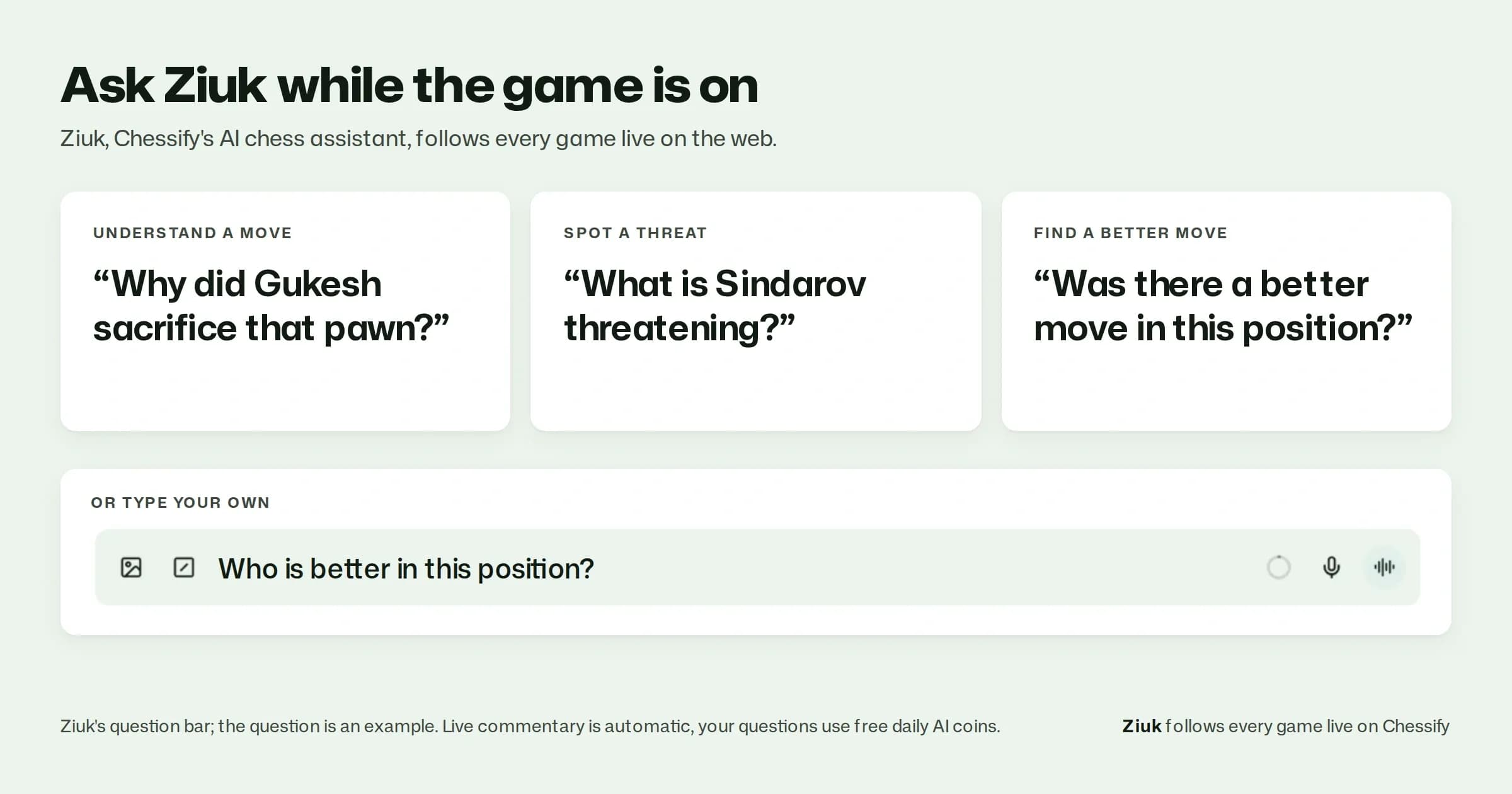
Open the live board with Ziuk on Chessify
The World Chess Championship will be available to follow online, with live broadcasts and expert commentary.
But watching the moves is one thing. Understanding why the world’s best players make them is another.
On Chessify, you can follow every World Championship game live with commentary from Ziuk, our AI chess assistant.
Ziuk highlights critical moments as they happen, explains the ideas behind moves, and helps you understand what’s changing on the board.
And when something isn’t clear, you can simply ask.
“Why did Gukesh sacrifice that pawn?”
“What is Sindarov threatening?”
“Was there a better move in this position?”
Ziuk uses powerful cloud chess engines and game databases to analyze the actual position and explain what’s happening, whether you’re an experienced player or just getting into chess.
Live commentary is automatic, while your own questions use the free daily AI coins available on your Chessify account.
Follow the World Championship live with Ziuk.
Live commentary is currently available on the web.
What should you watch for during the games?
World Championship matches are often decided by small details. With both players bringing months of preparation to the board, here are three things worth paying attention to.
What will the opening choices reveal?
Opening preparation plays a huge role in World Championship matches.
An unexpected move can take an opponent out of familiar territory, while a well-prepared novelty can create problems that are difficult to solve over the board.
With Sindarov playing White in Game 1, we’ll get our first glimpse of how he plans to challenge the defending champion.
How will the clock affect the players?
Time management can be just as important as finding the best moves.
Players have two hours to complete their first 40 moves, and spending too much time on an unfamiliar position early in the game can lead to serious time pressure later.
Watch not only what the players choose to play, but also how long they take to make those decisions.
When does the evaluation change?
Sometimes a single move changes the course of an entire game.
It might be a missed tactical opportunity, an inaccurate defensive move, or a quiet decision that gives one player a lasting advantage.
Following the engine evaluation can help you spot these turning points. And with Ziuk’s live commentary, you can go a step further and understand exactly why the position changed.
Frequently asked questions
When does the World Chess Championship 2026 start?
Game 1 begins on Tuesday, November 24, 2026, at 15:00 Geneva time. The opening ceremony takes place on November 22.
Where is the 2026 World Chess Championship?
The match takes place at Fondation Martin Bodmer in Cologny, near Geneva, Switzerland.
How many games are in the match?
The match consists of up to 14 classical games. The first player to reach 7.5 points wins the title. If the score is tied 7–7, tiebreaks will take place on December 12.
Who has White in Game 1?
Javokhir Sindarov plays White in Game 1. The players alternate colors in subsequent games.
Where can I watch the games live?
You can follow the live broadcasts or watch on Chessify, where Ziuk provides AI commentary throughout the games and answers your questions about the positions.
How much money does the winner get?
The total prize fund is $2.5 million. The final distribution depends on the number of classical games won and whether the match is decided through tiebreaks.
Don’t just watch the World Championship. Understand every move.


