



Chessify Database Upgrade: FEN Search, No Duplicates, Faster Results
Chessify’s Mega and ICCF databases are now cleaner, faster, and searchable directly from any FEN, with fewer duplicate games and automatic updates.
We have made a major upgrade to both the Chessify Mega Database and ICCF Database.
The databases are now cleaner, considerably faster, easier to search, and kept current through automatic updates. The overall game count has decreased because we removed a large number of duplicate records, leaving a more accurate collection of unique games.
Most importantly, you can now search the database directly from any position using its FEN—you no longer need the complete game starting from move one.
Here is what has changed and what each improvement means in practice.
- Search the database directly from any FEN
- Fewer duplicate games and more reliable statistics
- Much faster search performance
- Improved “Ignore Rapid and Blitz” filter in the Mega Database
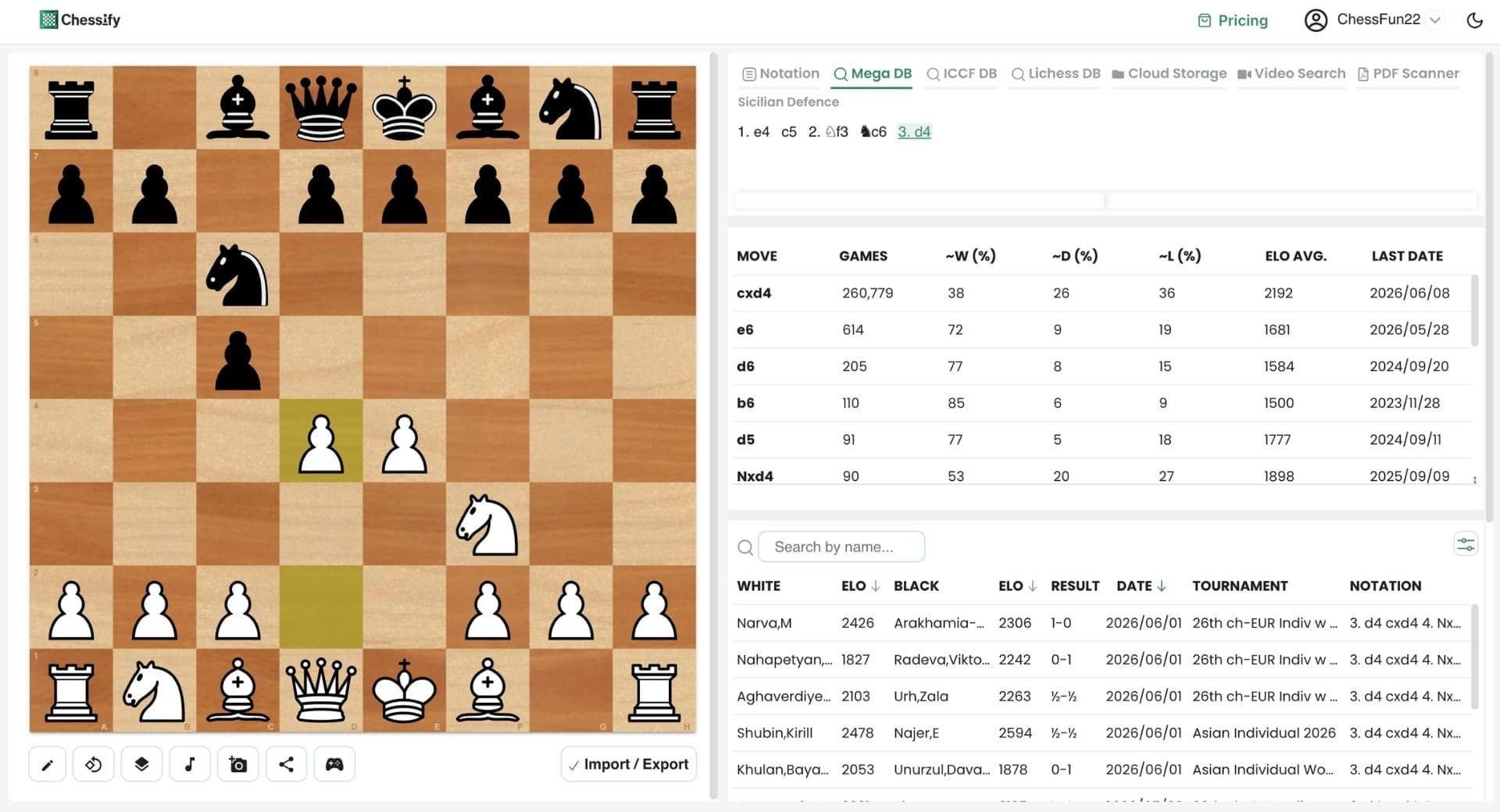
Search the database directly from a FEN
Previously, the Chessify database search was not available when you only had a specific position without its move history. You needed the game notation, beginning from the initial position, to find matching games in the database.
Now, the database can search directly from the FEN of the current position. For example, you might copy a position from a book or reconstruct it from an image, and the database will still find games in which it occurred.
A position can often be reached through several different move orders. FEN search allows Chessify to focus on the position itself rather than requiring one exact path that led to it.
Cleaner databases with no duplicate games
Duplicate games are a common but serious problem in large chess databases. The same game may appear several times because it was collected from different sources, published under slightly different event names, or stored with small differences in its metadata.
We have now removed as many duplicate games as we could identify from both the Mega and ICCF databases. As part of this upgrade, the total number of games in the database has decreased, which is intentional.
This is not only about making the total game count look cleaner. Duplicates can directly affect research by:
- making a position appear more common than it really is;
- distorting win, draw, and loss percentages;
- repeating the same game across multiple pages of results;
- and of course, wasting time when reviewing supposedly different reference games.
No deduplication process across millions of historical games can guarantee that every possible duplicate has disappeared, especially with the amount of similar games in online tournaments. However, the new database is substantially cleaner, making search results and statistics far more useful.
Faster database search
We have also significantly improved the speed of the database.
Position searches, game searches, and filtering now return results much faster. This improvement becomes especially noticeable when working with frequently played positions that may have thousands of matching games. Instead of waiting for the database to process a large result set, you can explore alternatives, adjust filters, and continue your research more smoothly.
The speed improvement applies to both the Mega Database and the ICCF Database.
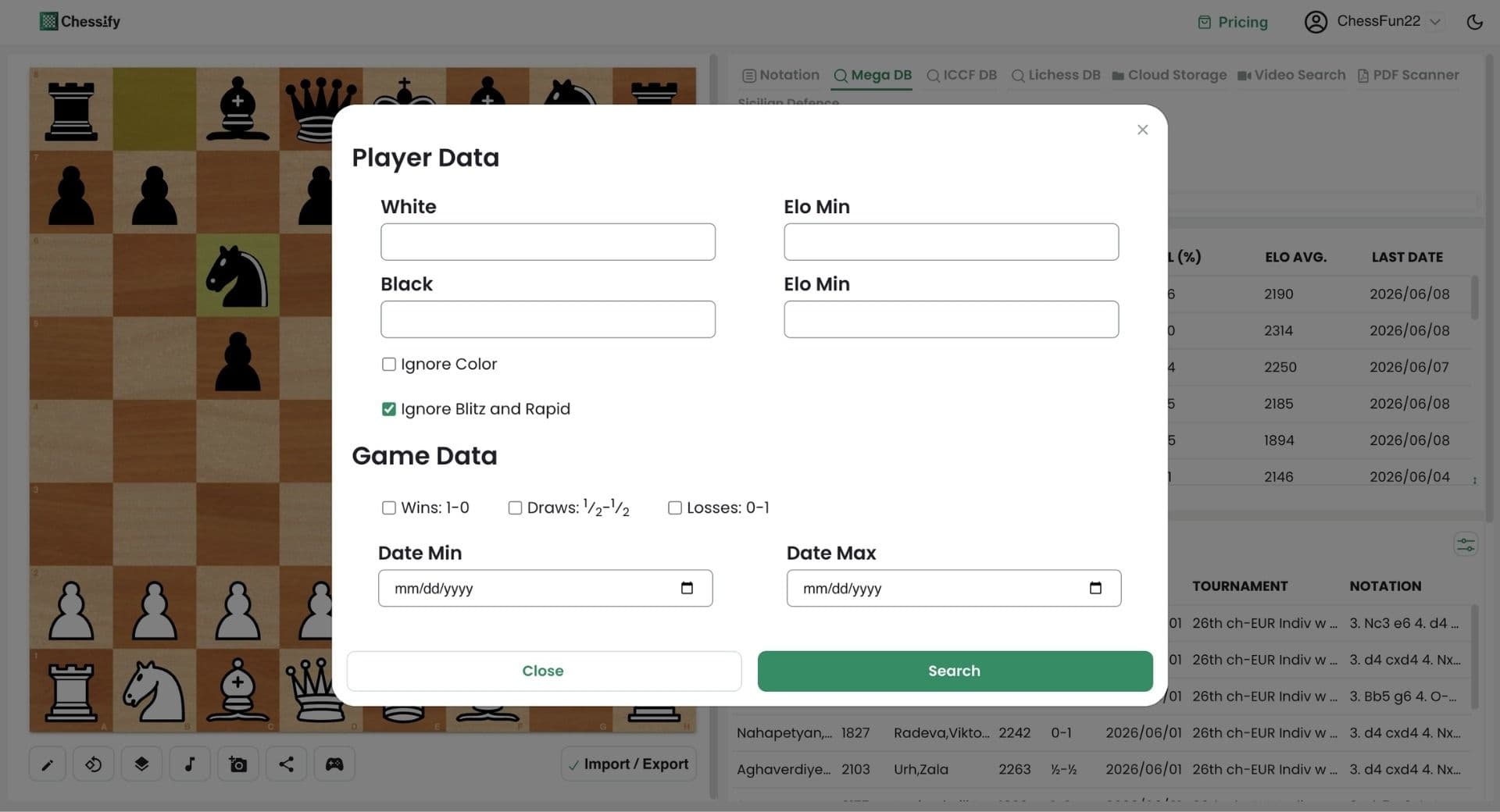
A more accurate “Ignore Rapid and Blitz” filter
For players studying openings or preparing for classical games, rapid and blitz games can sometimes add unnecessary noise to the results.
Fast time controls often produce more experimental openings, practical decisions, and mistakes caused by limited thinking time. These games can still be highly valuable, but they do not always belong in research focused specifically on classical chess.
We have refined the Ignore Rapid and Blitz filter so that it identifies and removes a lot more rapid and blitz games from Mega Database results than before.
This gives you greater control over the type of games included in your research:
- keep the filter disabled when you want the widest possible collection of practical examples;
- enable it when you want to focus more closely on classical games.
This particular improvement applies only to the Mega Database. It is not relevant to the ICCF Database, since correspondence chess is not divided into rapid and blitz time controls.
Updated through June 9, 2026
The Mega Database now includes games played through Tuesday, June 9, 2026.
Having a large historical database is useful, but modern opening research heavliy depends on recent games. New ideas can appear in elite tournaments, online events, national leagues, and open competitions every week.
Database updates will also be performed more consistently from now on, so users will have access to newly available games every Tuesday.
- the Mega Database will be updated weekly;
- the ICCF Database will be updated monthly.
The goal of this upgrade was not to make the database look larger, but to make it cleaner, faster, and more reliable. With fewer duplicates, direct FEN search, better filtering, and regular automatic updates, both databases are now much more useful for serious preparation and everyday research.


